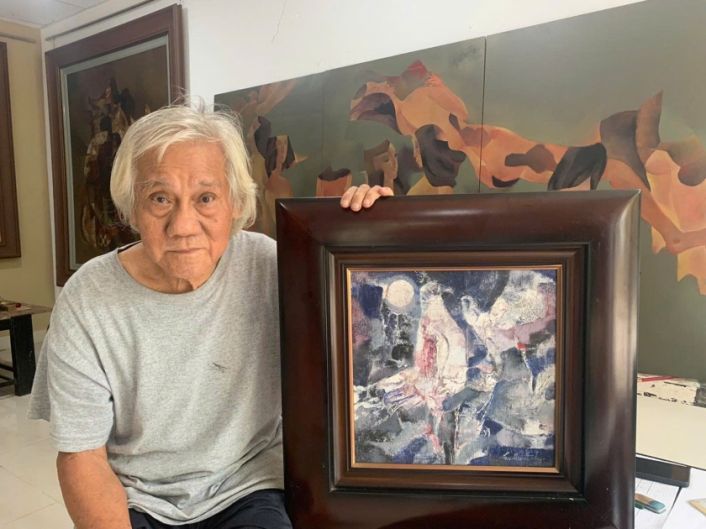
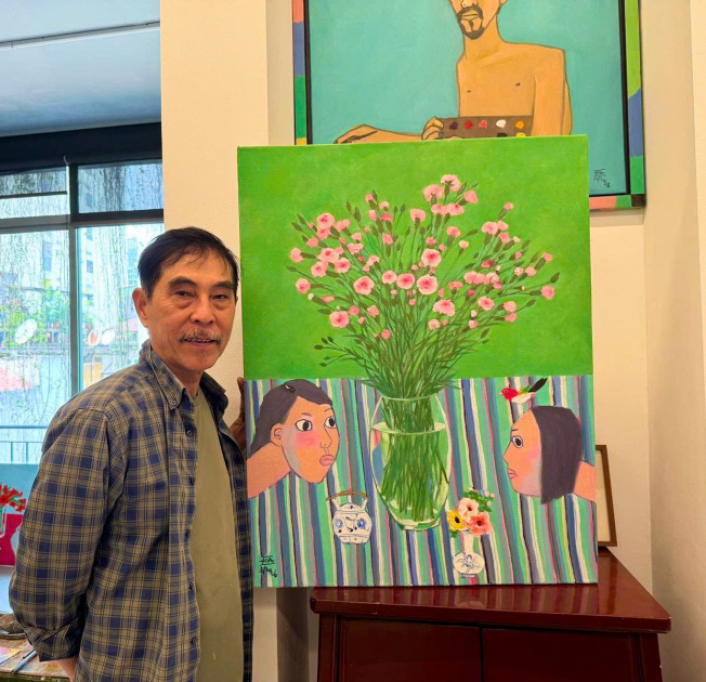
Some painters devote most of their lives to pursuing a particular painting style, while others are always looking for new possibilities in each medium and mode of expression. They experiment, change and renew themselves constantly through each creative period. The painter Nguyen Lam is one such noteworthy case in the history of modern Vietnamese art.
In his artistic journey, Nguyen Lam engaged with many painting tendencies, from realism, Impressionism and Expressionism to abstraction. He also succeeded in both oil and lacquer, two mediums with very different expressive qualities. In particular, his lacquer works show how a painter can embrace a traditional material while still finding a visual voice with a modern spirit.
Recognized not only through works of artistic value, Nguyen Lam also appeared in many exhibitions at home and abroad. His creative life is a story of perseverance, adaptability and a love of painting across many decades.
Who Is the Painter Nguyen Lam?
The painter Nguyen Lam, whose real name is Lam Huynh Long, was born in 1941 in Can Tho. He is one of the artists with a long career in modern Vietnamese art, particularly devoted to oil and lacquer painting.
From a young age, Nguyen Lam showed a talent for painting and early on chose to pursue art professionally. While studying, he began experimenting with new modes of expression rather than focusing only on reproducing images in a traditional manner.
One notable milestone in the early stage of his career was the Silver Prize at the Spring Painting Exhibition in 1962 in Saigon, for the work Solo (Doc tau). This achievement shows that Nguyen Lam’s creativity was recognized when he was still quite young.
After completing his art studies, he went on to teach at the Gia Dinh School of Decorative Arts. Alongside creating and teaching, Nguyen Lam also joined the Young Vietnamese Artists Association, taking part in a generation of artists interested in new approaches to modern painting.
According to the Nguoi Lao Dong newspaper, his works were selected for the Biennale de Paris in 1961 and 1963. This is a noteworthy milestone, showing that Nguyen Lam’s work was connected with the international art scene from quite early on.
A Creative Journey Through Many Painting Tendencies
What is special about Nguyen Lam’s career is that he did not confine himself to a single school. Instead, his creative process was a continuous movement between concrete imagery, personal emotion and abstract exploration.
Early Period: From Realism and Impressionism to Expressionism
In his first years in professional painting, Nguyen Lam began with modes of expression close to realism and Impressionism. This was a period in which the painter focused on form, scenery, light and the emotions evoked by the world around him.
However, he did not stop at describing what he saw. As he went deeper into creating, Nguyen Lam became more interested in expressing thoughts and emotional states through composition, color and the organization of line.
The work Desolate Sadness (Buon hoang, 1969) is a noteworthy example. The space in the painting is built from simple images such as a solitary stone bench, gaunt tree trunks and a deserted evening scene. Rather than using many details, the painter creates a feeling of emptiness through the very simplicity of the imagery.
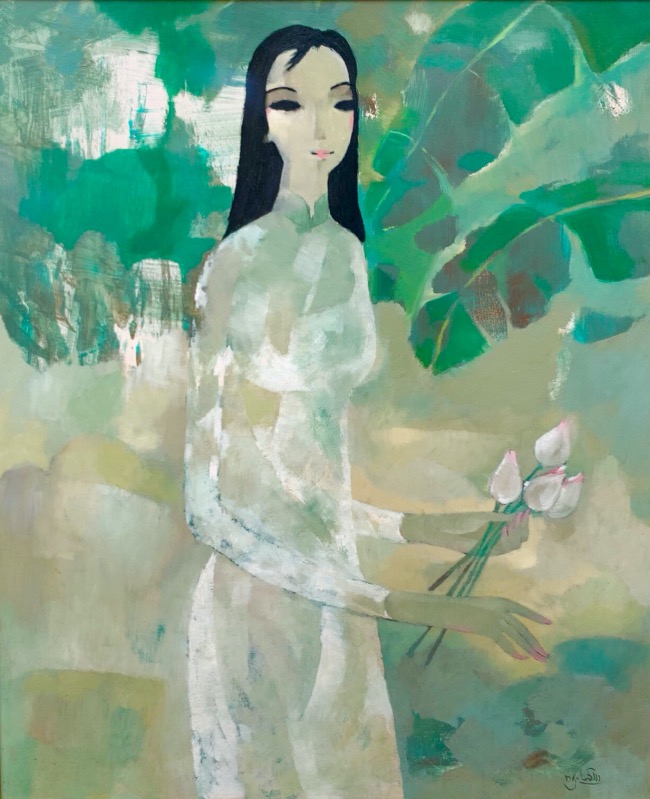
In 1972, the work Aspiration (Uoc vong) continued to show Nguyen Lam’s interest in Expressionism. The image of a girl in an ao ba ba (a traditional Vietnamese blouse) holding a bunch of white flowers is placed in a space with contrast between light and dark. The painting evokes the longing for peace at a time when the war still weighed heavily on social life.
These works show that Nguyen Lam sought not only to express visual beauty but also cared about the emotions and reflections behind the image.
When Abstract Painting Became an Important Direction of Exploration
A significant shift in Nguyen Lam’s career was his engagement with abstract painting from his student days at the National College of Fine Arts in Saigon.
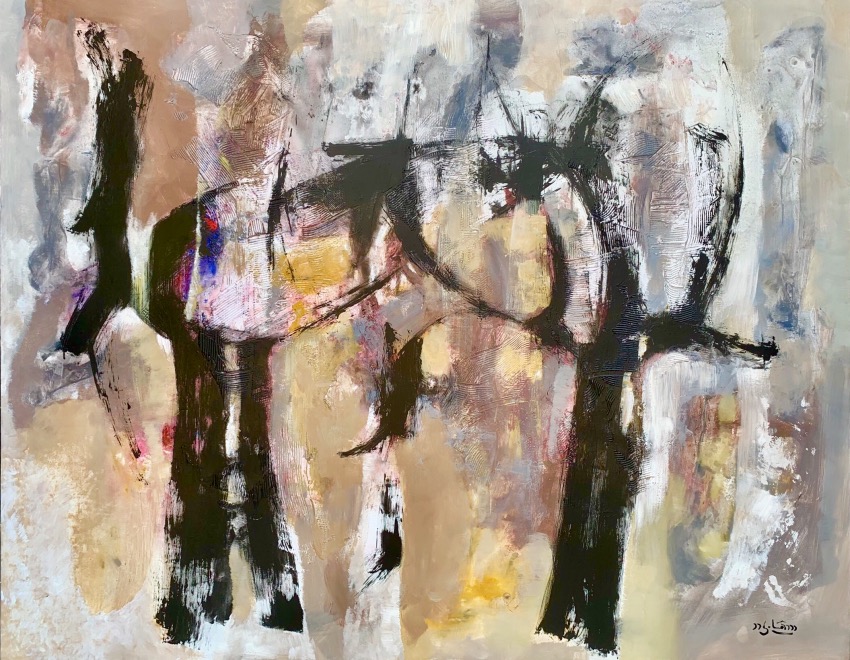
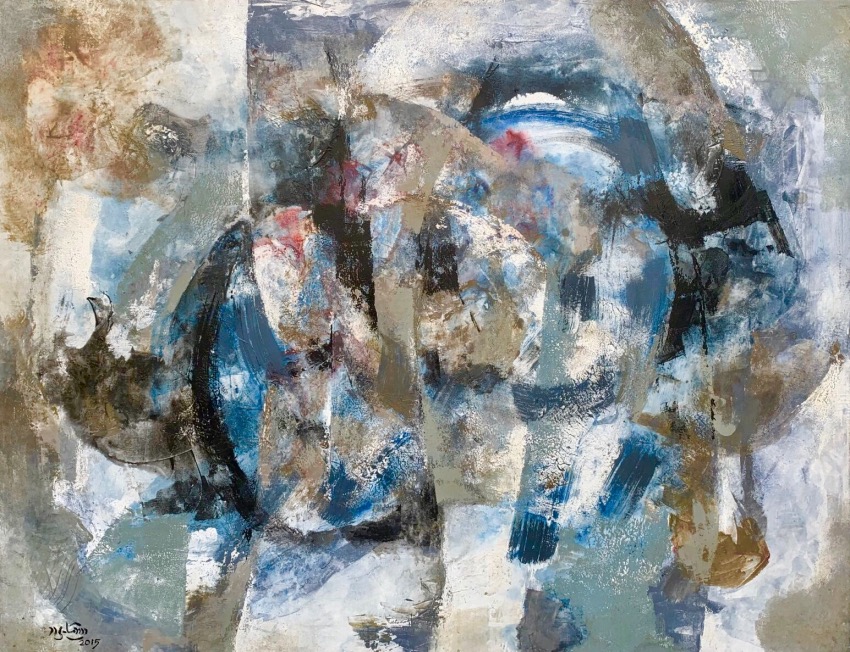
Instead of depending entirely on the shapes of concrete things, he began to draw on areas of color, line, form and the rhythm of composition to create a new world of imagery.
The two works Solo and Night Music (Nhac dem) are representative examples of these experiments. In them, geometric elements, lines and points of light are arranged in a way no longer bound by natural form.
Interestingly, although abstract, Nguyen Lam’s works remain connected with the emotions and experience of the artist. Areas of color do not exist merely to create form but also help build the rhythm and distinctive atmosphere of the painting.
This transition shows that Nguyen Lam did not see abstraction as abandoning his earlier painting values. He used his existing foundation in drawing to expand the limits of creativity, seeking freer ways of expression.
This is also one of the factors that make him a notable figure in Vietnamese abstract painting.
Nguyen Lam and His Mark on Vietnamese Lacquer Art
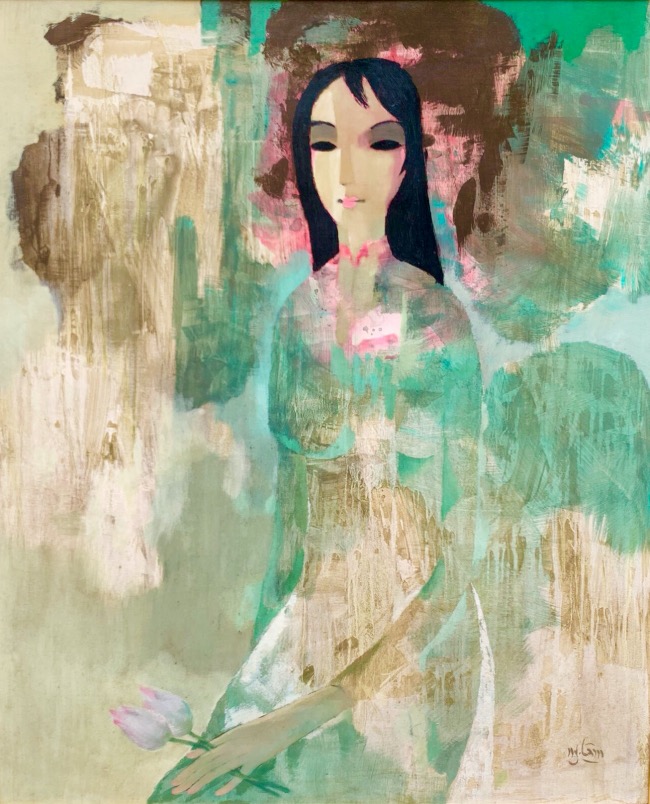
If oil painting let Nguyen Lam show flexibility in using color and line, lacquer opened another creative space, where he could explore the depth of the surface, contrast and the distinctive shimmering effects of the material.
Lacquer has long been tied to Vietnamese art. Over its development, this material has been used not only in handicraft products but has also become an important medium through which artists express painterly thinking.
For Nguyen Lam, creating in lacquer was not simply continuing a traditional technique. He sought to bring the material into modern structures of form, especially abstraction.
In many works, viewers can notice strong areas of color, an organization of imagery that does not follow a fixed template, and contrast between tones. Warm, deep colors, golds and surface effects create a space with visual depth.
Notably, he did not completely detach lacquer from its inherent values. Instead, the painter draws on the material’s properties to serve his personal ideas, so that the works retain the beauty of a traditional material while carrying a new creative spirit.
A study by Vu Tran Mai Tram on Nguyen Lam’s lacquer art also mentions a series of paintings inspired by the theme of hat boi, the traditional Vietnamese classical theater. This is a noteworthy direction, since hat boi is tied to traditional stage art, with its own system of figures, costumes and expressions.
By bringing this theme into lacquer paintings, Nguyen Lam creates a meeting between visual art and the national theatrical culture. The familiar images of hat boi are approached through his own painterly language rather than merely reproducing a scene performed on stage.
This is also an aspect showing that Nguyen Lam’s work is not only directed at formal experimentation but also shows an interest in traditional Vietnamese cultural materials.
A Mark in Restoring Paintings by Nguyen Gia Tri
Besides creating, Nguyen Lam is also recognized for his understanding and handling of lacquer.
In 2013, he was chosen by the Consul General of France in Ho Chi Minh City to restore the large-format lacquer painting The Procession (Dam ruoc) by the master Nguyen Gia Tri, which measures about 1.8 x 3 m.
In 2014, the Ho Chi Minh City General Sciences Library again invited him to restore three works: Nostalgia for the North (Hoai niem xu Bac), Dancing Under the Moon (Mua duoi trang) and Abstract (Truu tuong).
These tasks require someone who not only has painting skills but also understands the properties of the material, the preservation of the surface and the stability of the work. For lacquer paintings, restoration calls for even more care, because each layer of material contributes to the final appearance.
Being entrusted with this work is an important milestone, showing that Nguyen Lam’s professional ability in lacquer is demonstrated not only through works he created but also through his ability to handle works by other artists.
Exhibitions and Recognition at Home and Abroad
Throughout his career, Nguyen Lam took part in many exhibition activities, from art events in Saigon to programs presenting art abroad.
His works were selected for the Biennale de Paris in 1961 and 1963. He also exhibited in Kuala Lumpur, New Delhi, New York and several other cities.
In later years, Nguyen Lam continued to appear in art exhibitions in Singapore. Solo and group exhibitions brought his works to more collectors and art lovers.
According to materials introducing and remembering the painter, Nguyen Lam’s works are held in the collections of the Vietnam Fine Arts Museum, the Ho Chi Minh City Museum of Fine Arts, the Singapore Art Museum and many private collections in Asia, Europe and America.
Over more than 60 years of artistic activity, he is recorded as having created about 1,200 works. This figure partly shows the scale of his output and the perseverance of the artist throughout a lifetime devoted to painting.
The Artistic Legacy and Influence of Nguyen Lam
Looking back at Nguyen Lam’s creative journey, what is noteworthy lies not only in the number of works or his participation in international exhibitions. His value also shows in his ability to continually seek new directions in art.
He worked with realism, Impressionism, Expressionism and abstraction, and devoted much energy to both oil and lacquer. These changes did not make for a disjointed creative process but show development in how the painter viewed and expressed the world.
In particular, bringing an abstract language into lacquer painting helped expand the expressive possibilities of a material long tied to the tradition of Vietnamese art. Rather than using lacquer only to reproduce familiar imagery, Nguyen Lam also explored the depth of color, surface and form to build new artistic structures.
Another aspect of his legacy is his role in teaching and inspiring creativity within his family. Many of Nguyen Lam’s children went on to pursue painting professionally, making a family with several members working in the fine arts.
In his final years, despite his advanced age, Nguyen Lam continued to work in painting and produced many large-scale works. The image of an artist still working tirelessly at the easel until his last years is a memorable part of his creative journey.
View more paintings by Nguyen Lam →