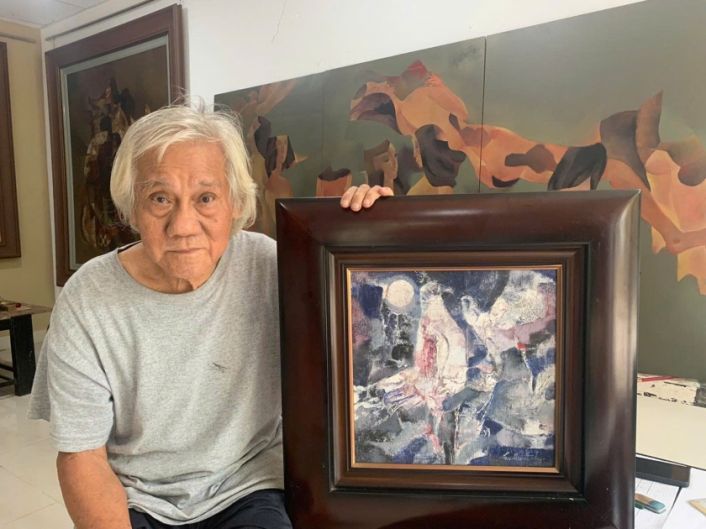
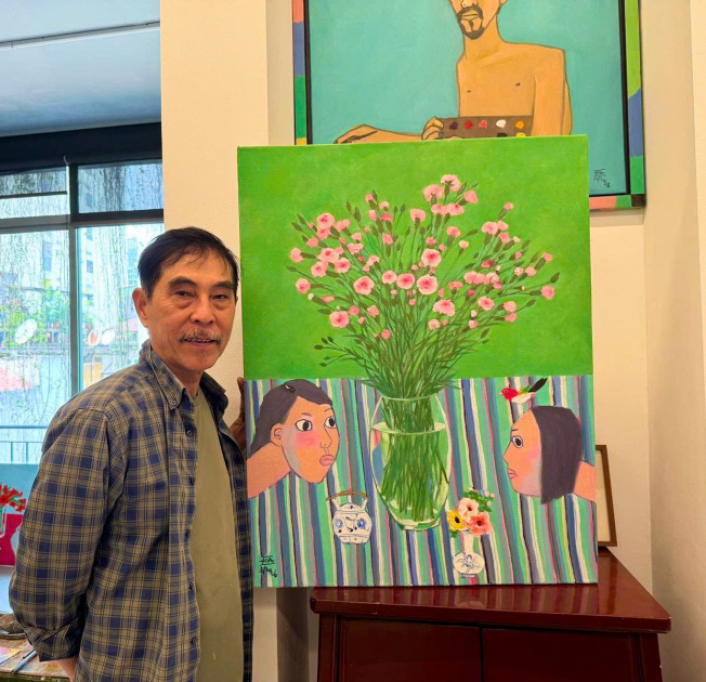
In painting, some artists begin creating from a carefully prepared idea, while others find their artistic path through emotion and natural instinct. For them, painting is not simply a process of reproducing what is seen, but a way of bringing the inner world onto the surface of the canvas through color, line and form.
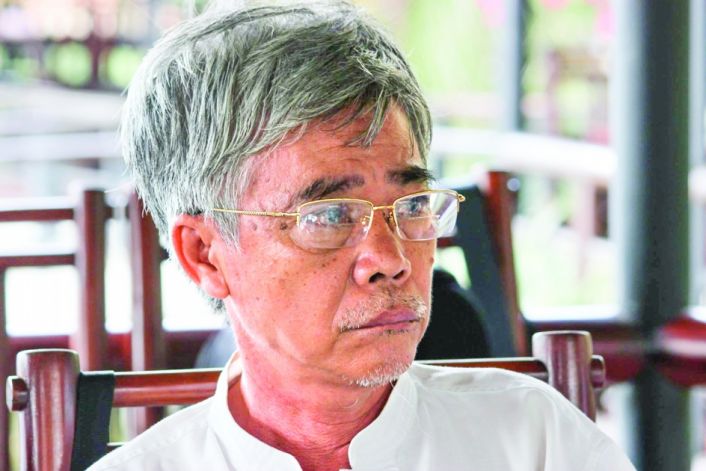
The painter Van Tho is a case that has drawn much attention from the architect Hoang Trinh in his written impressions. Through the comments recorded in the source material, readers can picture a style of creation rich in emotion, one that values freedom of expression and has a special connection with modern architectural space.
What is noteworthy in Van Tho’s painting lies not only in his use of color or composition, but also in a strong, unpredictable creative spirit not limited by familiar molds.
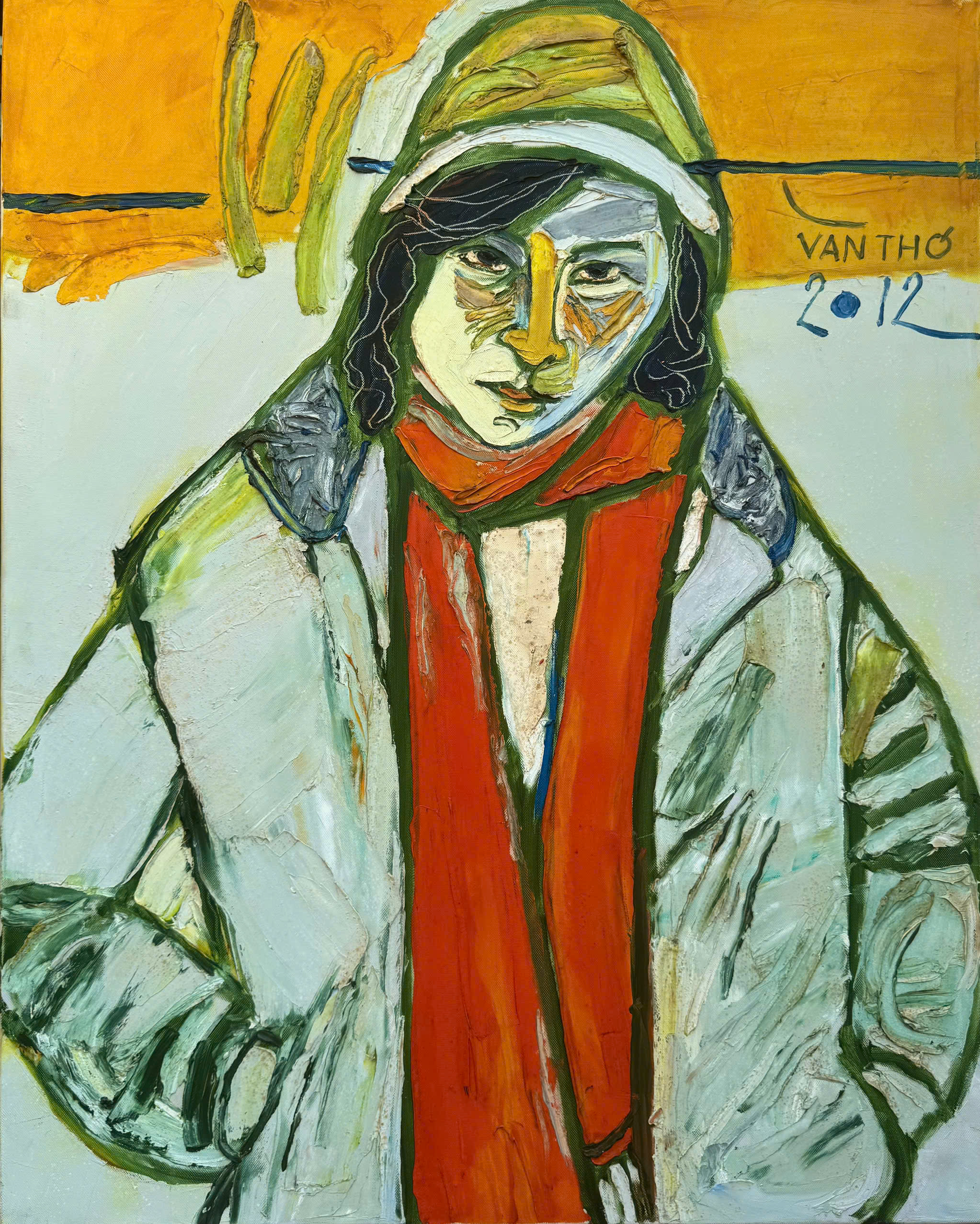
The Painter Van Tho Through the Eyes of Architect Hoang Trinh
In an article on the theme Public Opinion and Artworks, architect Hoang Trinh gave many special comments to the painter Van Tho, especially when mentioning the book titled Van Gogh’s Eyes, Van Tho’s Eyes – Vietnamese Contemporary Painting.
In Hoang Trinh’s perception, Van Tho possesses certain qualities that remind him of three great names of modern world painting: Picasso, Matisse and Van Gogh. This is a comparison based on the writer’s artistic impression, not an assertion that Van Tho’s style completely resembles those three masters.
Hoang Trinh notices four noteworthy characteristics in Van Tho: a somewhat spontaneous passion, a strong painterly instinct, an aspiration toward a universal artistic language, and the ability to organize space through visual thinking.
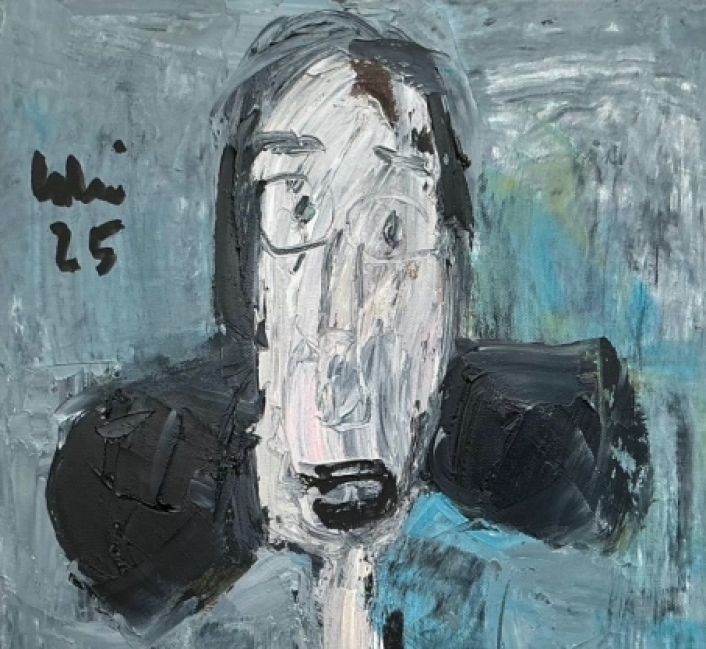
These characteristics lead him to see Van Tho as an artist not easily confined to familiar modes of expression. Instead of merely repeating existing motifs, colors or lines, the painter seeks his own way of expression, creating works with a clearly personal mark.
In particular, Hoang Trinh uses the image of a visual architect to speak of Van Tho’s ability to organize imagery in his paintings. According to him, the painter has not only a feeling for color, material and form but also shows precision in how he arranges the elements of form.
Van Tho’s Painting Style: A Combination of Emotion and Instinct
One of the most prominent points in Hoang Trinh’s comments is the role of emotion and instinct in Van Tho’s creative process.
According to the article, Van Tho does not necessarily begin a work with specific content or a ready-made model. He often picks up the brush and works according to inner urges. Images, forms and emotions accumulated in his mind gradually turn into a language on the surface of the painting.
For the painter, painting seems to have become a natural activity, as familiar as eating or breathing. Creating does not always need a clear destination from the start. What matters is the ability to recognize and express what is present in the inner world.
This approach creates a difference between painting according to a ready-made plan and creating based on emotion. The painter may not know exactly what shape the final work will take when he begins. It is the continuous process of working with color and form that opens up new directions of development.
Hoang Trinh says that Van Tho often names a work only after it is finished. This reflects a view of creation in which content and meaning do not necessarily have to be determined in advance but can gradually take shape from the creative process itself.
However, that freedom does not mean a lack of control. Behind the instinctive brushstrokes there is still the participation of thought, the ability to choose and adjust. Emotion provides the initial energy, while awareness helps the painter recognize what should be kept, added or simplified.
Visual Language and the Expressive Power of Color
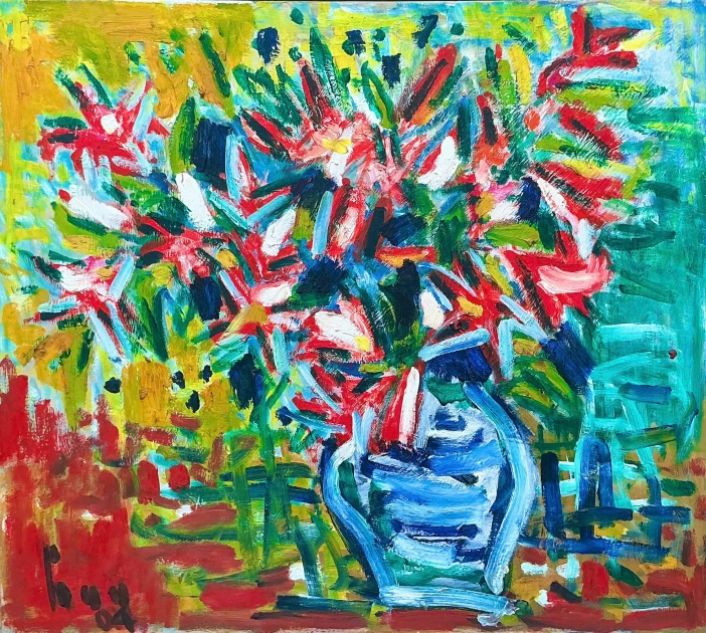
In his comments on Van Tho’s paintings, Hoang Trinh pays particular attention to how the painter handles color, material, form and composition.
Rather than caring only about what story a painting tells, viewers are encouraged to notice how visual elements combine. Color can create rhythm, form opens up a sense of space, while composition determines the movement of the whole image.
From this point of view, a work of painting does not necessarily need to rely on a specific subject to be appealing. The way form is organized and the relationships between visual elements can also convey powerful emotion.
Hoang Trinh remarks that Van Tho has the ability to find unexpected choices in the creative process. It may be a little-noticed subject, a seemingly limited space, an unusual color scheme or a hard-to-predict approach to composition.
What deserves attention is that these choices are not merely meant to create novelty of form. They help express the painter’s own way of seeing the world around him.
In painting, a small change in color or the position of a form can sometimes alter the viewer’s overall perception. For Van Tho, according to Hoang Trinh’s description, the search for new formal solutions is itself an important part of creative activity.
The source material also mentions Van Tho’s oil paintings, showing that this painting material is part of the works presented. However, what Hoang Trinh focuses on more is not the name of the material, but how the painter draws on the means of painting to express emotion and visual thinking.
Van Tho’s Paintings and Their Connection to Architectural Space
A special feature of architect Hoang Trinh’s comments is the way he views Van Tho’s paintings from the standpoint of architectural space.
As someone working in architecture, Hoang Trinh is interested not only in the individual value of each work but also in how they interact with their surroundings.
According to him, Van Tho’s paintings can make a space more lively, striking and deeper. When placed in a suitable environment, a work is not merely a decorative object but can help shape the emotion and aesthetic value of the whole space.
Hoang Trinh particularly values the combination of Van Tho’s paintings with buildings of modern architecture that emphasize intellect and simplicity of form. He believes such spaces can help the works bring out their visual value better.
In the article, he also relates the way Van Tho’s paintings exist in space to works by famous architects such as Mies van der Rohe, Walter Gropius, Louis Kahn, Le Corbusier, Zaha Hadid and Daniel Libeskind.
This is a comparison showing Hoang Trinh’s interest in the relationship between the plastic arts and architecture. If architecture organizes space through structure, materials and form, painting can add emotion, color and visual language to it.
From this perspective, Van Tho’s paintings are evaluated not only as independent works but also as an element capable of creating an identity for display and living spaces.
Notably, Hoang Trinh shares that he once displayed paintings by other painters in his own creative space but felt the environment became ordinary. He then replaced them with Van Tho’s paintings and noticed a change in the aesthetic feeling and inspiration of the space.
This sharing shows the writer’s attachment to Van Tho’s works, and also reflects the influence painting can have on people’s perception of a space.
Emotion and Reason in Van Tho’s Painting
Hoang Trinh goes on to address two important elements in Van Tho’s creative process: emotion and reason.
He uses a richly figurative expression: emotion is perceived with one eye, while reason is seen with both eyes. This is not a division in the ordinary visual sense, but a metaphor describing two different aspects of artistic activity.
According to Hoang Trinh, emotion helps viewers recognize the deeper aspects of a work such as aspiration, simplicity, affection, excitement, reflection, sadness or a state of exhilaration. These are the elements that make up the soul and the unconscious world of the artist.
Meanwhile, reason plays the role of observing, evaluating and adjusting. It helps the painter recognize whether a work is complete, and whether a detail needs to be added, removed or clarified.
If emotion creates the urge to begin creating, reason helps that process arrive at a more purposeful form. The two elements are not necessarily mutually exclusive but take part together in the formation of the work.
This is also a noteworthy point in how Hoang Trinh views Van Tho’s painting. Although he stresses instinct and freedom, he still recognizes the presence of thought and control behind the work. A painting may begin from stirrings hard to name, but to be completed, the artist still needs clarity of mind in choosing and organizing the image.
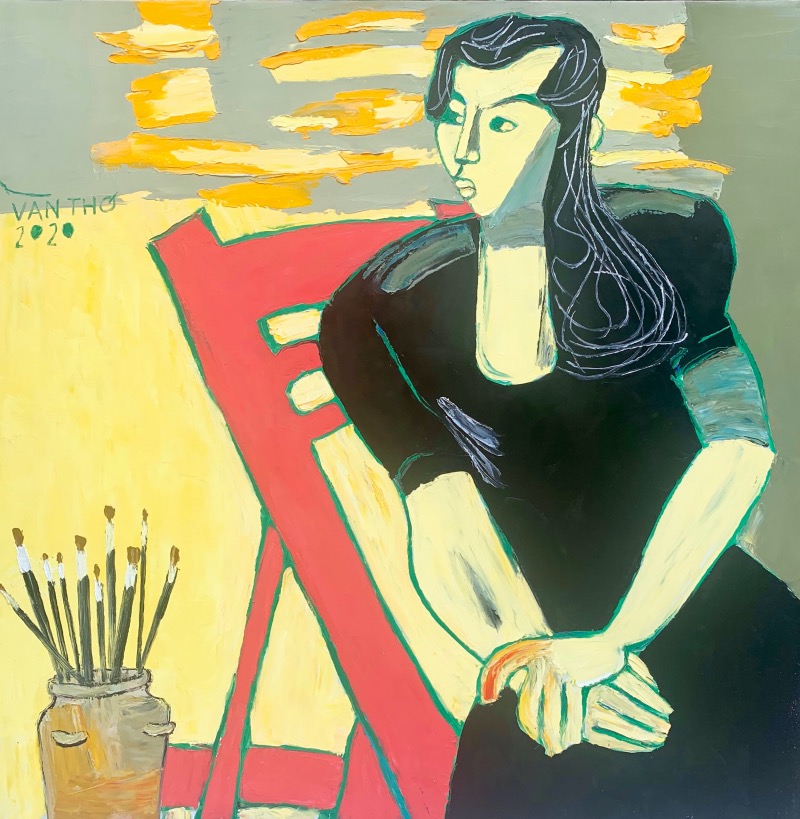
The Power of Large-Scale Works
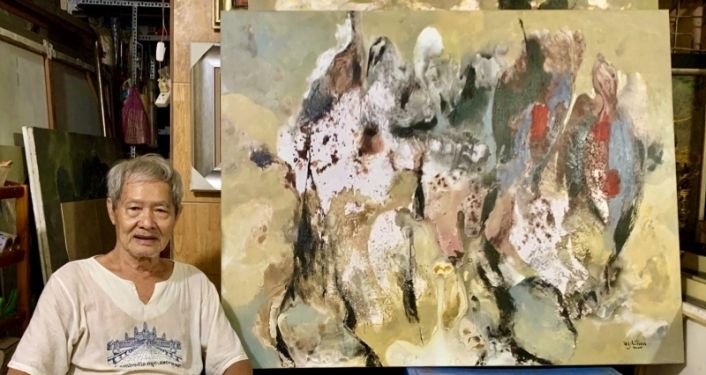
Hoang Trinh pays separate attention to Van Tho’s large-format paintings.
He believes that the larger the work, the stronger the visual feeling it creates, even somewhat overwhelming. However, what is noteworthy lies not only in the physical size but also in the sense of space and limits the work evokes.
In Hoang Trinh’s words, some paintings seem to go beyond the limits of the frame itself. Viewers do not merely take in the image within the surface but also feel the expansion of form, color and emotion.
A large-scale painting usually poses different demands on composition and visual balance. The visual elements must be sufficiently connected so as not to feel disjointed, while also creating harmony when viewed from different distances.
Hoang Trinh’s comments show that he highly values the ability of Van Tho’s paintings to create presence in space. This strength comes not only from size but also from the organization of imagery and the expressive energy of the work.
Painting as a Source of Creative Inspiration
Beyond professional comments, Hoang Trinh’s article also shows a close relationship between him and the painter Van Tho.
In his sharing, Hoang Trinh says he had long intended to visit Van Tho’s home to see the works in person. However, he wanted to be in a position not only to look at the paintings but also to own one by the painter.
What he regrets most is not yet being able to buy a Van Tho painting, but he still hopes to visit the artist one day.
In earlier articles, Hoang Trinh also repeatedly expressed that Van Tho’s paintings give him inspiration in his work of architectural creation. He regards the painter as a strong source of artistic energy, helping him find new approaches when he has difficulty developing ideas.
For an architect, technique and structure may be important elements in creating a building. However, artistic creativity calls for sensibility, openness and the ability to look at a problem from many directions.
According to Hoang Trinh’s account, Van Tho’s paintings have brought him such inspirations. This is also evidence of the connection between fields of art, as painting can become a source of inspiration beyond its own domain.
The Distinctive Mark of the Painter Van Tho in Vietnamese Painting
From these comments, it can be seen that what Hoang Trinh values in Van Tho is an independent creative spirit and an approach to painting not bound by ready-made formulas.
There, emotion serves as the origin, instinct drives the creative process, and reason helps complete the work. Color, form, material and composition become the means by which the painter expresses his inner world in his own way.
Another aspect that makes the comments on Van Tho special is the relationship between painting and space. The work is viewed not only through its content or form alone but also through its ability to change the viewer’s perception of the surrounding environment.
Of course, these evaluations are set within the perspective of a writer deeply interested in art and architecture. They do not replace a study of the painter’s entire body of work, biography or exhibition history. Nevertheless, they remain a noteworthy source for approaching some features of Van Tho’s artistic thinking.
The painter Van Tho appears, through the pages written by architect Hoang Trinh, as an artist who values emotion, instinct and freedom in creation. His works are seen not only through their visual expressiveness but also through their influence on space and the inspiration they bring to those who appreciate them.
From these impressions, readers gain another perspective for exploring Van Tho’s painting: an artistic world where emotion and reason coexist, where form is not only a means of expression but also an important part of creative thinking.