

Dinh Y Nhi Artist: Artistic Individuality in Every Brushstroke
In painting, not every artist seeks to win over viewers with beautiful pictures in the conventional sense. Some choose to confront the hidden corners of emotion, bringing images onto the canvas that are not entirely comfortable but make viewers think. The painter Dinh Y Nhi is one such case.
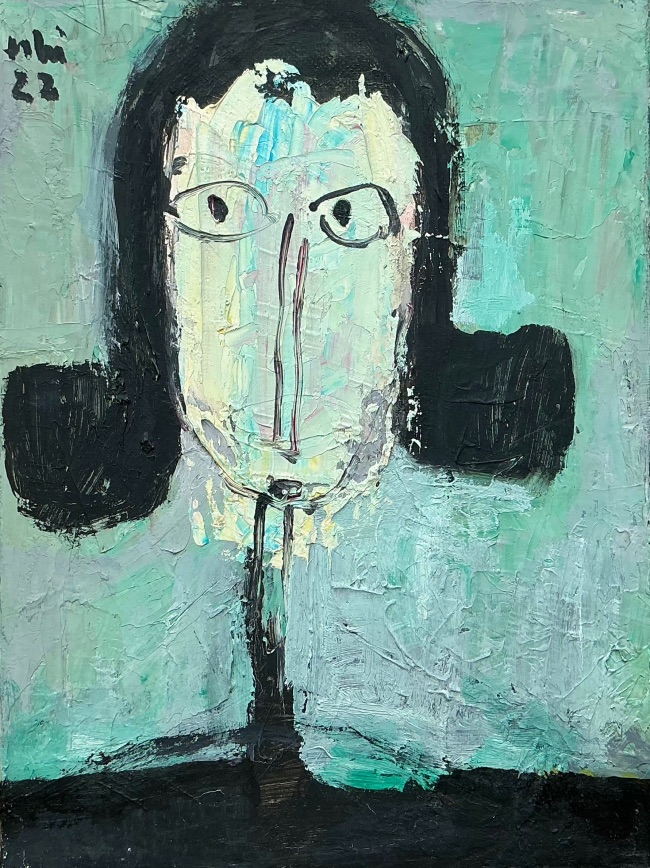
Born and raised in an artistic environment, Dinh Y Nhi developed her own painterly voice early on. Instead of following a realistic approach with balanced forms and harmonious color, Dinh Y Nhi often uses strong lines, simplified human figures and deliberately chosen palettes. Her paintings do not try to tell a story in a clear sequence; they are more like slices of mood, where emotion is expressed directly through imagery.
What is noteworthy is that this style does not stand still within a fixed mold. From the striking black-and-white works of the 1990s to oil paintings and dó paper works of later periods, Dinh Y Nhi has always embarked on new explorations of materials and modes of expression. This is also why her artistic journey holds its own appeal in the picture of contemporary Vietnamese art.
Biography of the Painter Dinh Y Nhi and Her Artistic Foundations
The painter Dinh Y Nhi was born in 1967 in Hanoi. She graduated from the Hanoi University of Fine Arts in 1989. Her thorough training in an art environment laid an important foundation for the development of the artist’s visual language. However, Dinh Y Nhi’s mark lies not in following the principles of academic painting but in the way the artist gradually built a personal mode of expression.
From the early years of her artistic activity, Dinh Y Nhi drew attention with works featuring distinctive imagery. While many works of the time turned to the beauty of scenery, daily life and familiar images, Dinh Y Nhi’s paintings focused more on people in complex psychological states.
In 2003, the solo exhibition titled The Inner World of Dinh Y Nhi in Hanoi to some extent showed this concern clearly. The title also suggests the artist’s approach to art: not simply observing the outside world, but searching for what is happening inside each person.
One noteworthy point in Dinh Y Nhi’s journey is that she never stops working with questions of form, emotion and expression. The artist does not need to create a character with a specific biography for viewers to recognize. Instead, the figures in her paintings can become representations of broader states of being: loneliness, unease, inner conflict, freedom or the longing to be oneself.
Dinh Y Nhi’s Painting Style: When Emotion Matters More Than Form
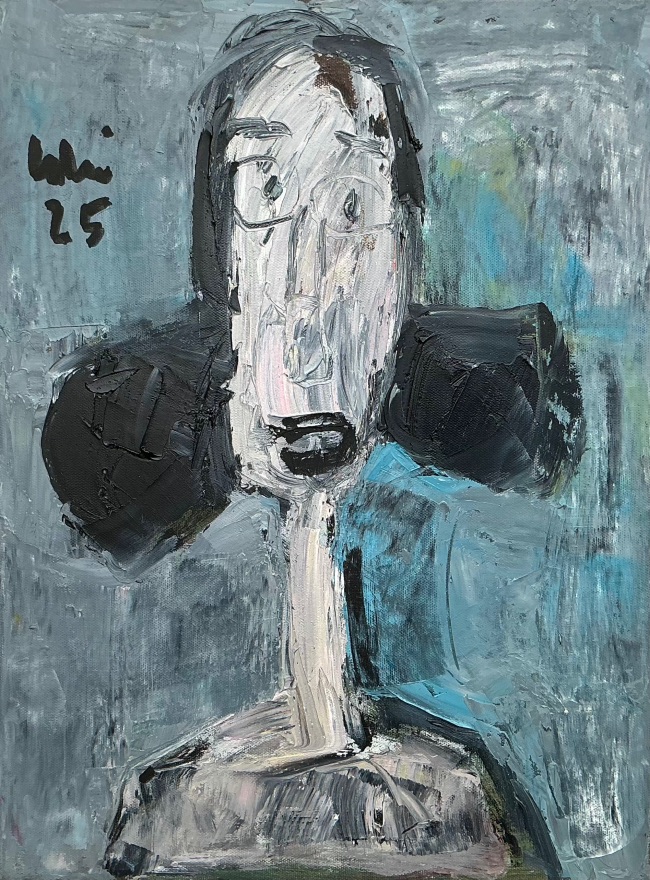
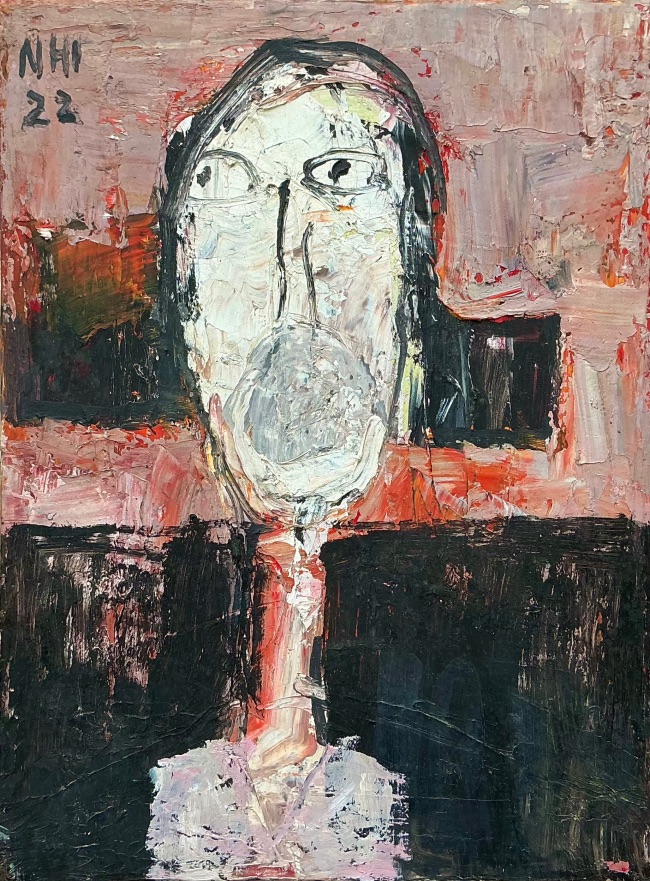
If one had to choose the most recognizable feature of Dinh Y Nhi’s paintings, it would probably be the way she handles the human figure. The figures in her works are usually not depicted in standard anatomical proportions. Forms may be elongated, distorted, condensed or placed in poses that do not follow ordinary rules.
But it is precisely this difference that gives the work its expressive power. Viewers do not necessarily need to recognize a specific face to sense what the painter wants to convey. A seated posture, a raised arm or a body curled inward can evoke a feeling of vulnerability, resistance or helplessness.
Expressionism and a Personal Visual Language
Dinh Y Nhi is often mentioned in connection with the Expressionist tendency. This is an artistic approach that emphasizes expressing emotion and subjective experience rather than reproducing the world accurately.
In her paintings, lines sometimes look scrawled, not polished in the conventional sense. However, this is not simply carelessness. Strong brushstrokes, at times overlapping and seemingly unstable, help create a rhythm of their own for the work.
A figure does not need a clear face to make viewers feel its presence. A distorted form does not necessarily carry a negative meaning; it can be the painter’s way of expressing the invisible pressures people must face.
This is also why Dinh Y Nhi’s paintings are not easily placed in the category of ordinary decorative art. The value of the work lies largely in the emotional experience and in the way viewers find their own empathy with the images before them.
Black and White: A Choice That Created a Distinctive Mark
In the early stage of her career, Dinh Y Nhi became widely known for works using the two colors black and white, sometimes with the addition of red. This is a noteworthy choice because the restriction of color forces the painter to seek expressive power through form, line and the relationship of light and dark.
Black and white in the artist’s paintings do not merely divide areas of light and dark. They create strong contrasts, making the figures stand out yet also somewhat distant. The space of the painting therefore often carries a feeling of tension, mystery and psychological depth.
Interestingly, when there is not much color to create visual effects, viewers find it easier to concentrate on the state of the figure. A lone form against a paper ground can create a feeling of emptiness; several figures appearing together evoke complex relationships without needing a specific story to explain them.
This is one of the reasons Dinh Y Nhi’s black-and-white works became an important mark in the formation of her style.
People and the Condition of Women in Dinh Y Nhi’s Paintings
People are one of the themes running through Dinh Y Nhi’s work. However, Dinh Y Nhi does not focus on portraying physical beauty or building portraits in the traditional way. The female figures in her paintings often appear imperfect, sometimes naked, solitary or in poses full of tension.
Behind these images lies an interest in the condition, emotions and position of women in life. They do not necessarily represent a specific social type. They can be independent individuals carrying their own thoughts and contradictions.
The Security series, presented in a solo exhibition at Thavibu Gallery in Bangkok in 2009, is a noteworthy example. The exhibition comprised 15 large-format oil paintings, all focusing on the image of a naked woman in many different poses.
Here, the image of the body carries more than a physical meaning. It also raises questions about safety, exposure, autonomy and the way people view themselves. The name Security creates a thought-provoking contrast: when the body is placed in a state of exposure, does a person truly feel safe?
This way of exploring the theme shows that Dinh Y Nhi does not avoid sensitive issues. She uses direct imagery to open up broader reflections on personal life and the limits people must confront.
The Search for Materials: From Gouache and Oil to Dó Paper
A special aspect of Dinh Y Nhi’s career is the process of changing and experimenting with materials. If one looks only at her famous black-and-white works, one might think the artist was tied to a fixed way of working. But in reality, the artist’s journey is much richer.
Gouache: First Steps of an Expressive Language
In the early part of her career, gouache was one of the materials Dinh Y Nhi used. With its relatively direct character, this material allowed her to concentrate on form, areas of color and line without needing many complex layers of treatment.
Works on paper from this period helped shape her way of building strong, simplified and highly expressive imagery.
Oil Paint: A Dialogue with the Material
Later, oil paint became an important part of her artistic practice. Unlike the directness of gouache, oil requires the painter to handle many factors such as thickness, coverage, surface and layering.
Notably, in a conversation published by Nhan Dan newspaper in 2016, Dinh Y Nhi shared that oil paint remained a difficult material for her, even after more than two decades of practice. This shows that mastering a material does not mean the artist has exhausted its possibilities.
In her oil paintings, the forms usually have a heavier material presence. Areas of color and layers of paint create a surface with depth, contributing to the sense of the existence of the human body.
Dó Paper: A New Creative Direction
2016 marked a noteworthy period when Dinh Y Nhi presented a series of works on dó paper in the exhibition My Little Happiness.
Dó paper is a material long familiar in traditional Vietnamese art. However, rather than using this material in a gentle, decorative manner or keeping its familiar qualities, the artist explored its expressive potential in her own direction.
The works in this series use watercolor on dó paper, creating a difference from her earlier black-and-white images and oil paintings. Blues, yellows, pinks and reds appear in the works titled My Little Happiness, creating a brighter feeling without losing the depth of reflection that has always been present.
This change is not simply a shift from black and white to color. It shows that an artist can continue to explore herself through materials that seem to have become all too familiar in the history of Vietnamese art.
What Makes the Painter Dinh Y Nhi’s Mark Distinctive?
There can be many ways to explain the appeal of Dinh Y Nhi’s paintings, but what is most worth noting is the consistency in how she views people while constantly changing her modes of expression.
First, the artist does not depend on formal beauty. The figures in her paintings do not need to be perfect in proportion or line. It is precisely the unusual forms that help convey emotion directly.
Second, her art is strongly personal. Instead of trying to build stories easy for everyone to understand, Dinh Y Nhi leaves space for viewers to feel for themselves. A painting can evoke different interpretations depending on each person’s experience.
Third, she constantly searches for new possibilities in materials. From gouache to oil paint to dó paper, each choice opens a different mode of expression. The change does not erase her identity but shows the capacity of a personal painting language to develop.
Perhaps for this reason, Dinh Y Nhi’s paintings do not always create a good impression at first viewing. Some works may leave viewers puzzled by strange forms or a heavy feeling. But on closer observation, one can recognize the questions about condition, emotion and existence being raised behind each image.
Dinh Y Nhi’s Place in Contemporary Vietnamese Art
In the context of Vietnamese art with many different directions, Dinh Y Nhi has made her mark by following a relatively independent path. Dinh Y Nhi did not choose an approach that is easy to accept from the start, nor did she limit herself to a particular material or palette.
The artist’s works show that contemporary Vietnamese painting does not revolve only around reflecting landscape, history or social life. Art can also go deep into private experience, psychological contradiction and issues of personal identity.
In particular, the way Dinh Y Nhi explores the image of women offers a thought-provoking perspective. The female figures in her paintings do not appear only to show beauty but also have a voice, an existence and emotional states of their own. They may be fragile but not entirely passive, solitary yet still holding a strong presence.
This is one of the artist’s noteworthy contributions to the diversity of visual language in Vietnamese art. Instead of creating a painting formula that others can easily recognize, Dinh Y Nhi shows the value of persevering with personal thought and experience.

10/04/2020
Ethereal Charm - Vietnam artist Ho Huu Thu
Most important artist of Gia Dinh Fine Arts College
DETAILS


12/22/2017
The famous Vietnamese sculptor and painter Lê Công Thành
Le Cong Thanh and the question of the human condition
DETAILS

10/13/2017
“Day, Night and Day” Exhibition by Artist Nguyễn Tấn Cường
Solo exhibition of Vietnam Artist Nguyen Tan Cuong
DETAILS


10/05/2017
A Showcase of Contemporary Vietnamese Art
The exhibition of Ha Tri Hieu is curated by Tran Luong
DETAILS

02/24/2017
Vietnam Artist Dang Xuan Hoa
The one of most important artists of the late 20th century
DETAILS

02/12/2017
GIADINH FINE ARTS SHOOL – HOCHIMINH FINE ARTS UNIVERSITY
Gia Dinh Fine Arts School
DETAILS


12/14/2016
Le Thang is the one of best 3D goldfish artists
Beautiful 3D Goldfish Paintings from Vietnam artist
DETAILS