

Hua Thanh Binh: A Journey Between Art and Heritage
Born in 1957, Hua Thanh Binh is a figure with a distinctive artistic journey in contemporary Vietnamese art. He has not only devoted many years to creating but has also worked in teaching, management and the preservation of fine art. The combination of professional experience and a passion for painting has helped shape a style of creation that is both rich in emotion and attentive to technique and cultural value.
The Painter Hua Thanh Binh and His First Years with Art
Hua Thanh Binh was born on June 21, 1957. From a young age, he chose to pursue painting and gradually built his professional foundation through art training.
In 1974, he graduated from the secondary-level fine arts program at the Gia Dinh National School of Decorative Arts. He then continued his studies at the Ho Chi Minh City University of Fine Arts. According to an in-depth article published in 2025, he studied the secondary-level fine arts program between 1975 and 1978 before completing the university program between 1981 and 1985.
This extended period of study gave Hua Thanh Binh a solid professional foundation. It was not only a time for training his powers of observation, composition and form, but also helped him develop a serious attitude toward materials, technique and the process of completing a work.
What is noteworthy is that his artistic path did not develop in a direction focused only on exhibiting or seeking public attention. From his early years, Hua Thanh Binh chose a rather quiet rhythm of life, devoting much of his time to work and creating.
A Journey Combining Creating, Teaching and Museum Work
One distinctive point in Hua Thanh Binh’s biography is the long-standing connection between his artistic activity and his work at cultural institutions.
In 1978, he began working as a painter at the Revolution Museum, now the Ho Chi Minh City Museum. His time there lasted until 2000. In the following period, he moved to teaching at the Faculty of Fine Arts, Ho Chi Minh City College of Culture and Arts.
From 2000 to 2010, he took on teaching duties and once held the position of Head of the Faculty of Fine Arts. With his practical experience and professional foundation, he took part in training many generations of students pursuing painting.
In 2010, Hua Thanh Binh returned to the Ho Chi Minh City Museum of Fine Arts as Deputy Director in charge of professional affairs. He held this position until his retirement. In this way, the museum was not only a place where he worked for a long period but also a space tied to many stages of his career.
The years spent in contact with artworks, artifacts and exhibition activities gave him a deeper perspective on the value of materials and the durability of a work of art. For Hua Thanh Binh, creating does not stop at producing a beautiful image. A work must also be carefully treated technically so that it can last and retain its value over time.
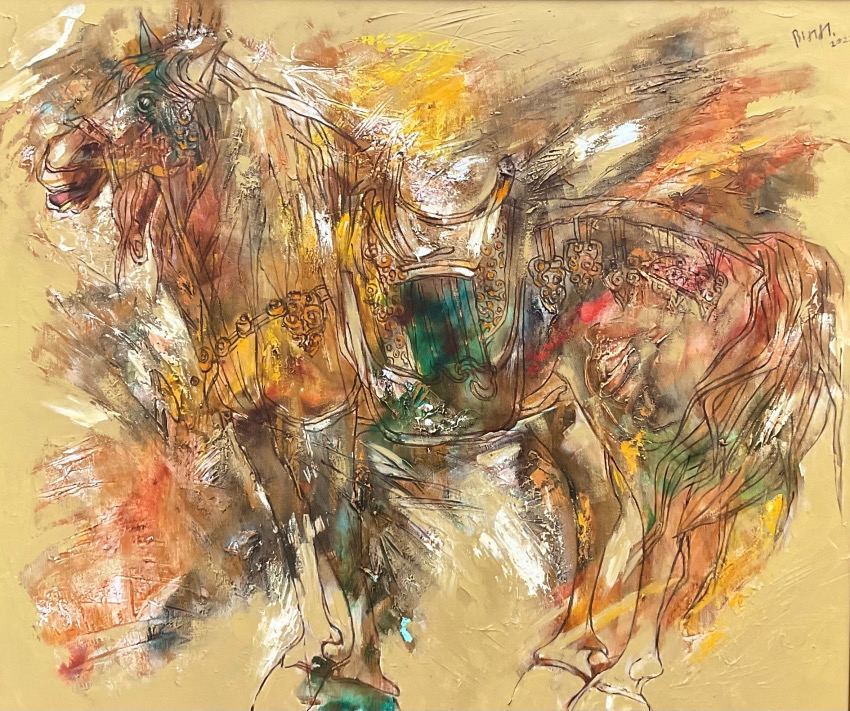
The Painting World of Hua Thanh Binh: When Traditional Imagery Takes on a New Look
Looking at many of Hua Thanh Binh’s works, viewers may notice a few images that return often, especially horses, young women, dragons and patterns tied to traditional culture.
What is noteworthy is that these images are not treated as mere illustrative subjects. They are placed in diverse visual relationships, sometimes blending with decorative patterns, areas of color and expressive lines. As a result, familiar imagery can take on a different appearance, both evoking tradition and showing a modern artistic mind.
The Horse: A Symbol of Emotion and Movement
The horse is one of the prominent images in Hua Thanh Binh’s work. In his paintings, this animal may appear in a quiet manner with sad eyes, or in a state of powerful movement, hooves flying through open space.
The image of the horse is therefore tied not only to strength or physical beauty. Through the painter’s treatment, it also evokes emotions such as loneliness, loyalty, endurance and a longing for freedom.
Young Women and Layers of Cultural Memory
Alongside the horse, the image of women also appears in many of Hua Thanh Binh’s works. The female figures often have a slender, gentle and reserved bearing, set in spaces rich in decorative elements.
Some works combine the image of a young woman with ancient motifs, patterns and cultural symbols. This combination creates a link between people and traditional memory, while also widening the expressive possibilities of the visual language.
In addition, images of Ly dynasty dragons, Champa patterns, communal house carvings and folk art are also noteworthy sources of inspiration. These cultural materials are brought into the paintings not to be reproduced as they are, but to be transformed through the painter’s way of seeing and exploration.
This approach helps Hua Thanh Binh’s paintings keep a connection with traditional art without being confined to old molds.
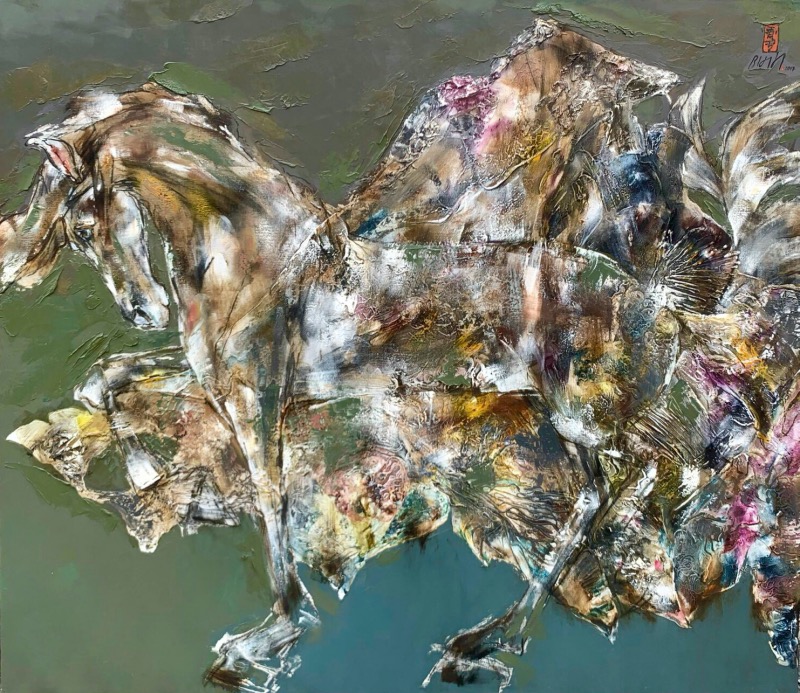
Oil, Acrylic and Lacquer: A Constant Search in Materials
Beyond subject matter, material is an important aspect that helps identify Hua Thanh Binh’s creative journey.
For many years, oil paint was the material he used regularly. The ability of oil to build layers, shift tones and treat surfaces gave him favorable conditions to express imagery with depth, from the human figure to the movement of animals and complex decorative areas.
Not stopping at a familiar material, he also experimented with acrylic and later studied lacquer more deeply. According to materials introducing him in 2025, he began trying his hand at lacquer from early 2019.
Exhibitions at Home and the Journey of Taking Vietnamese Painting to the World
Since the 1980s, Hua Thanh Binh has taken part in art exhibitions in Ho Chi Minh City and many localities across the country. Between 1985 and 2010, he joined many group exhibitions and also presented works at art spaces in Singapore, Thailand, Hong Kong, China, Japan, South Korea, Russia, the United States, France and Germany.
His solo exhibitions also mark memorable milestones. In 1996, he presented works in Paris, France. Two years later, he exhibited at Gallery Vietnam in Ho Chi Minh City and the Goethe Institute in Hanoi. In 2006, his works were again presented at Hanoi Studio Gallery. In 2008, he had exhibition activities in Hannover, Germany and in Switzerland.
A special milestone in this journey was the exhibition Opening the Door – 30 Years of Fine Art in the Doi Moi Period (1986–2016). In September 2016, Hua Thanh Binh was one of 50 representative fine art authors selected for presentation at the Vietnam Fine Arts Museum.
His presence in international art activities shows that his paintings have had the opportunity to reach many different groups of audiences and collectors. Hua Thanh Binh’s works are now recorded in many private collections in the United Kingdom, France, Germany, the United States, Singapore, Hong Kong, Japan, South Korea, Switzerland, Russia and Vietnam.
The Painter Hua Thanh Binh and His Distinctive Mark in Vietnamese Art
Looking back at Hua Thanh Binh’s career, it can be seen that he is an artist active on many fronts. He has created, taught, worked in museums and taken part in professional activities in Ho Chi Minh City’s fine arts scene. However, in whatever position he held, painting has always remained an important part of his life.
What is memorable in Hua Thanh Binh’s paintings is the way he brings familiar images of Vietnamese culture into a visual space with a modern breath. Horses, young women, dragons or ancient patterns serve not only as decoration but also open up many associations about people, time and memory.
He also shows a serious attitude toward his profession by never ceasing to study materials, experiment with techniques and keep creating through many stages of his life.
For Hua Thanh Binh, the value of painting lies not in chasing passing trends, but in finding one’s own voice and patiently nurturing it. His works therefore carry a personal mark while adding a perspective on the relationship between contemporary art and Vietnamese cultural identity.

10/04/2020
Ethereal Charm - Vietnam artist Ho Huu Thu
Most important artist of Gia Dinh Fine Arts College
DETAILS


12/22/2017
The famous Vietnamese sculptor and painter Lê Công Thành
Le Cong Thanh and the question of the human condition
DETAILS

10/13/2017
“Day, Night and Day” Exhibition by Artist Nguyễn Tấn Cường
Solo exhibition of Vietnam Artist Nguyen Tan Cuong
DETAILS


10/05/2017
A Showcase of Contemporary Vietnamese Art
The exhibition of Ha Tri Hieu is curated by Tran Luong
DETAILS

02/24/2017
Vietnam Artist Dang Xuan Hoa
The one of most important artists of the late 20th century
DETAILS

02/12/2017
GIADINH FINE ARTS SHOOL – HOCHIMINH FINE ARTS UNIVERSITY
Gia Dinh Fine Arts School
DETAILS


12/14/2016
Le Thang is the one of best 3D goldfish artists
Beautiful 3D Goldfish Paintings from Vietnam artist
DETAILS