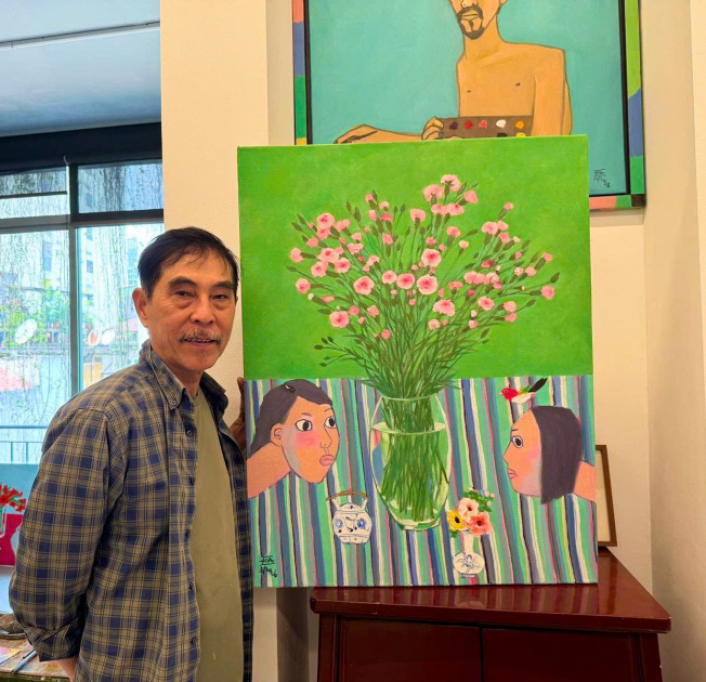
In the history of modern Vietnamese painting, there are artists who spend their entire lives searching for a visual language that resonates with their inner world. For Ho Huu Thu, this journey did not follow a straight path. He began with academic drawing, encountered Impressionist painting, and later expanded his artistic exploration into Surrealism, Symbolism, and Abstraction. Throughout this process, oil painting and lacquer became two important mediums through which he expressed his thoughts, emotions, and highly evocative imagery.
If lacquer painting earned Ho Huu Thu the nickname “the lacquer art magician,” his oil paintings reveal another side of his artistic thinking. In these works, color, form, light, and space are handled with flexibility to create worlds that feel both familiar and mysterious.
In Ho Huu Thu’s paintings, viewers may encounter young women, lotus flowers, birds, horses, music, or moonlight. These images are not simply reproduced as objects visible to the eye. Instead, they are often transformed through the artist’s use of color, line, and emotion.
A creative journey spanning more than six decades established Ho Huu Thu as a noteworthy figure in Vietnamese fine art. He remained connected to tradition while continuously searching for new possibilities within painting.
Who Was Ho Huu Thu?
Ho Huu Thu was born in 1940 in Thu Dau Mot, Binh Duong. He graduated from the National College of Fine Arts in Saigon in 1964. Before 1975, he was involved with the Young Artists Association in Saigon and later became a member of the Ho Chi Minh City Fine Arts Association and the Vietnam Fine Arts Association.
Ho Huu Thu’s artistic journey began at an early age. In the mid-1950s, he studied at the Thu Dau Mot School of Applied Arts and Crafts, graduating in 1959. He then continued his studies in painting at the Gia Dinh College of Fine Arts and completed the program in 1964.
After graduation, he both taught and pursued his own artistic practice. In 1968, he was among the founders of the Young Vietnamese Artists Association in Saigon.
One notable aspect of Ho Huu Thu’s career is that he did not devote himself exclusively to a single medium. Alongside lacquer painting, he also created oil paintings and explored various approaches to artistic expression.
Ho Huu Thu’s Early Life and Artistic Foundations
Ho Huu Thu grew up in an environment with a long tradition of handicrafts and applied arts. His early exposure to art provided an important foundation for his interest in color, form, and artistic techniques.
He was introduced to various aspects of applied art and craftsmanship. This experience became an important foundation before he entered a professional environment for studying fine art.
In 1960, Ho Huu Thu continued his studies at the Gia Dinh College of Fine Arts. During this period, he had the opportunity to develop his foundations in figure drawing, composition, color, and visual thinking.
Another notable milestone came in 1960, when he received an award in an art competition organized by ESSO.
The years of study and teaching that followed provided an important foundation for his long artistic career. Ho Huu Thu not only learned how to observe the world around him but also gradually searched for ways to transform those observations into a personal visual language.
Oil Painting in Ho Huu Thu’s Artistic Journey
When discussing Ho Huu Thu, many people remember him by the title “the lacquer art magician.” However, when looking more broadly at his artistic journey, oil painting is also an important aspect that deserves attention.
Sources on Ho Huu Thu indicate that he studied and practiced painting before moving more deeply into the modernization of lacquer art. A 2024 commemorative article also noted that throughout his career, he explored various artistic tendencies and created abstract works in both oil and lacquer.
Oil painting offered Ho Huu Thu a different space for artistic expression. While lacquer requires the artist to work through multiple layers of material, carefully treat the surface, and polish it through a labor-intensive process, oil allows color and brushwork to be applied more directly and flexibly.
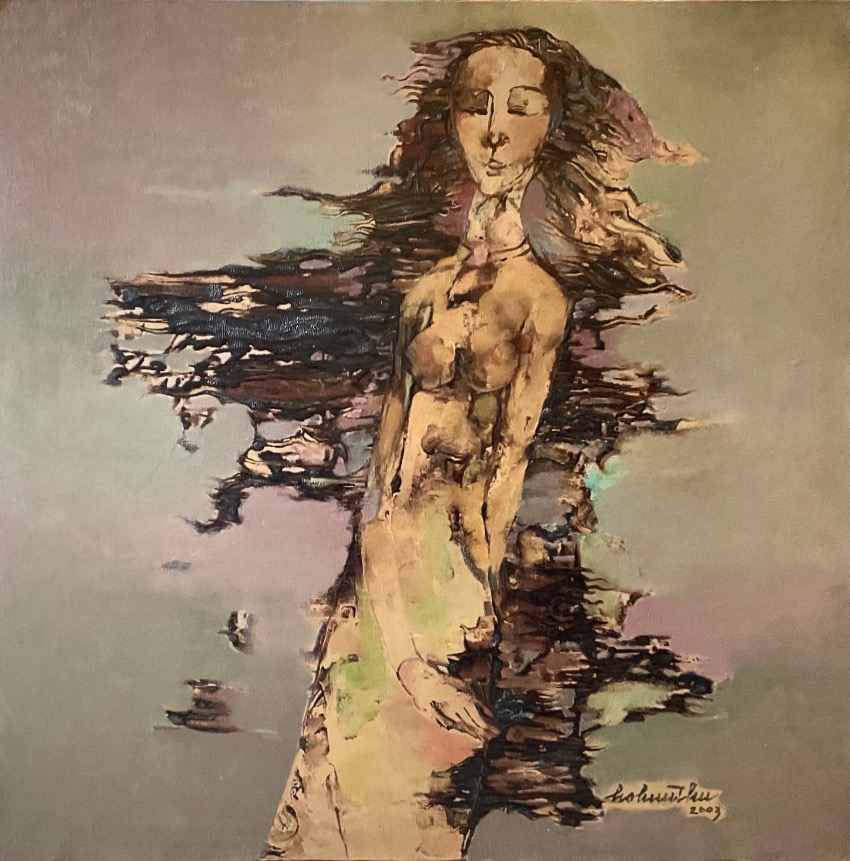
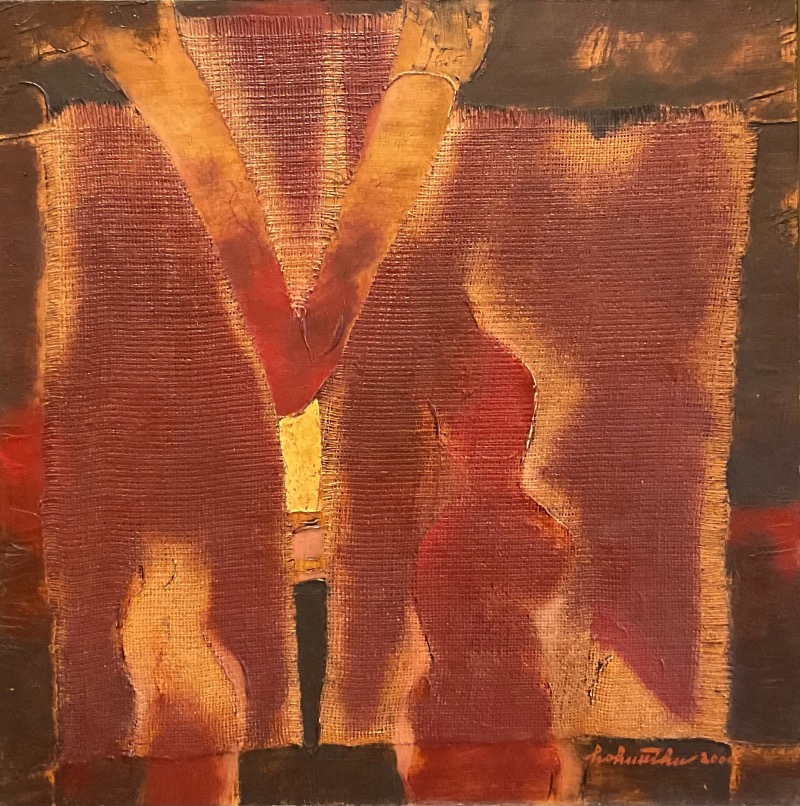
In his oil paintings, color can become a vehicle for emotion. Forms do not necessarily need to be depicted in meticulous detail; they can be simplified, elongated, transformed, or placed alongside contrasting areas of color.
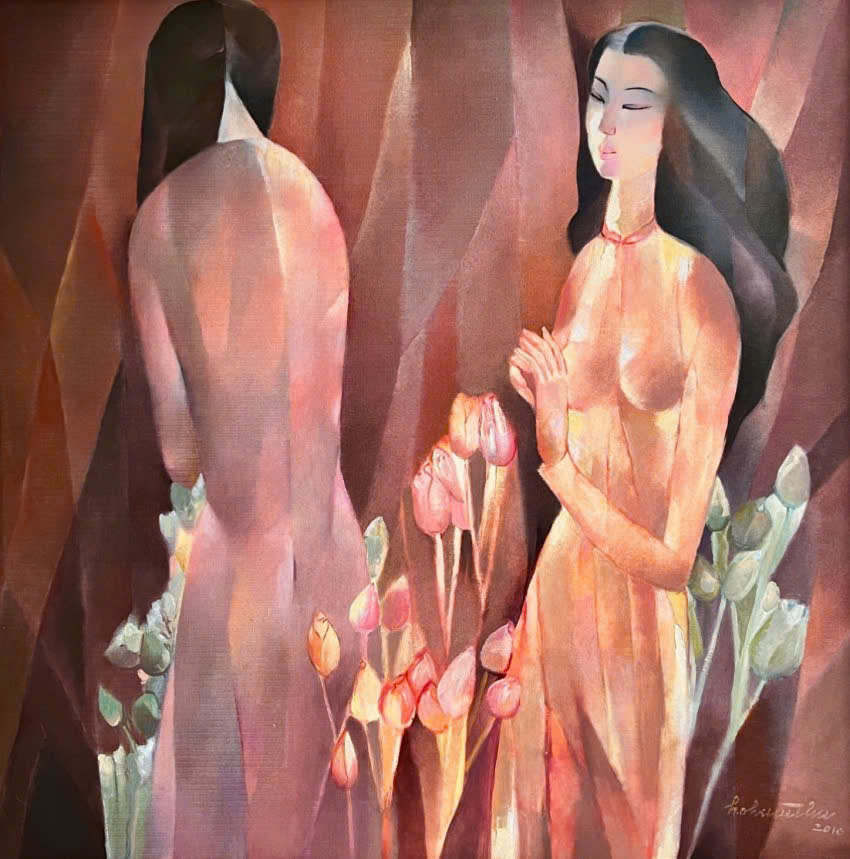
According to materials published for the 2026 commemorative exhibition, in his oil paintings, Ho Huu Thu often used tones such as green, gray, pale pink, and ochre. These colors create a relatively subdued, soft, and contemplative palette.
This is also an important aspect of his painting: color does not merely serve to describe objects but also contributes to creating the atmosphere of the entire work.
From Academic Drawing to Impressionism, Surrealism, and Abstraction
Ho Huu Thu was not confined to a single fixed style. His artistic journey can be described as a continuous transition from academic drawing and Impressionism to Surrealism and eventually toward Abstraction.
1. Academic Drawing and the Influence of Impressionism
In the early stages of his career, drawing played an important role in Ho Huu Thu’s education and artistic practice.
His emphasis on form enabled him to construct figures, spaces, and compositions with a solid foundation. From there, he encountered the influence of Impressionist painting, particularly in its approach to color and light.
Rather than treating color simply as something applied to form, an artist can use color to create atmosphere, rhythm, and emotion. This became one of the important foundations for the transformations that later emerged in Ho Huu Thu’s visual language.
2. From Reality to the Surreal World
After his period of interest in drawing and Impressionism, Ho Huu Thu continued to explore Surrealism.
Within the surrealist world, familiar images do not necessarily have to appear in logical relationships as they do in everyday life. A young woman may stand within an undefined space, a lotus flower may appear beside an unrealistic form, while the moon can become an element carrying symbolic meaning.
This approach corresponded with Ho Huu Thu’s evolving artistic interests, as he increasingly focused on emotion, intuition, and the layers of association lying behind visible imagery.
3. Entering Abstract Painting
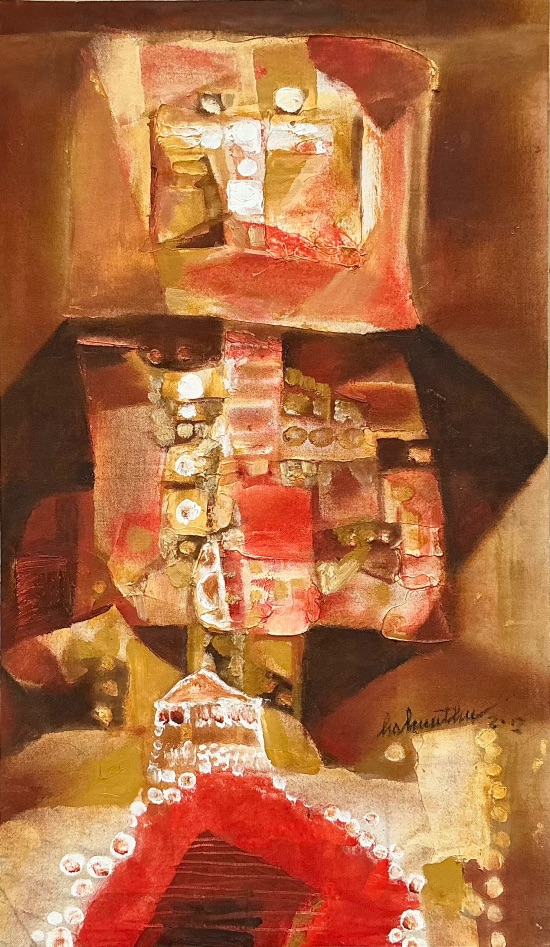
Later, Ho Huu Thu moved more strongly toward abstraction. At this stage, images no longer necessarily needed to remain clearly recognizable.
A figure might be reduced to a few lines. A flower might become a series of color fields. Space might no longer follow conventional rules of perspective.
What matters at this point is not whether the viewer can identify exactly “what it is,” but rather the feeling generated by the work as a whole.
His abstract works in both oil and lacquer have been described as romantic and dreamlike, drawing viewers into a world filled with imagination and reverie.
Color and Space in Ho Huu Thu’s Oil Paintings
If one were to identify a particularly notable aspect of Ho Huu Thu’s oil paintings, color would certainly be an important point of entry.
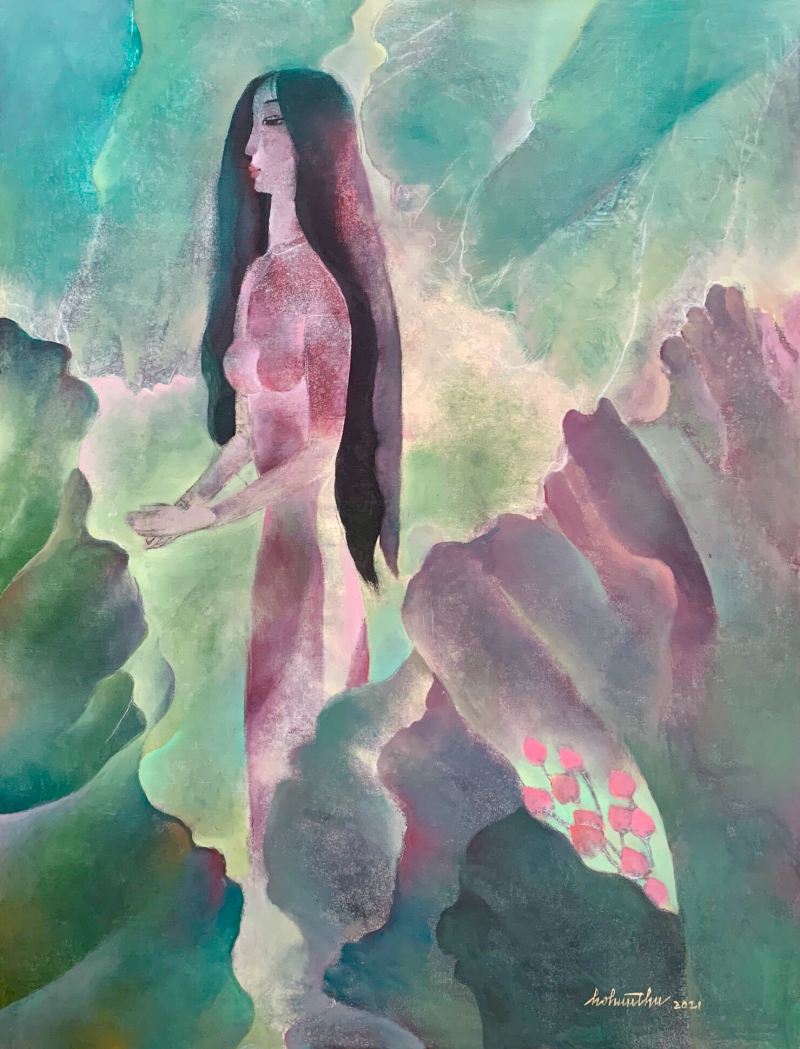
The greens, grays, pale pinks, and ochres mentioned in materials about his oil paintings create a relatively gentle and profound atmosphere.
Color in a painting does not have to be vivid to make an impression. On the contrary, subdued tones can make the imagery quieter and create space for the viewer to reflect.
Space also plays an important role.
In some works, figures are placed within broad areas of empty space. This emptiness is not simply a background behind the subject; it can create a sense of solitude, ambiguity, or separation.
In other works, forms and colors seem to merge with one another. The boundaries between people, objects, and space become difficult to define.
This treatment gives Ho Huu Thu’s paintings a distinctive quality: the imagery remains rooted in the real world without being confined by it.
Familiar Motifs in Ho Huu Thu’s Paintings
Even as he moved toward abstraction, Ho Huu Thu frequently returned to symbolic images such as young women, lotus flowers, birds, horses, music, and moonlight.
The Female Figure
The female figure is one of the prominent images in Ho Huu Thu’s artistic world.
Women in his paintings are often presented with a sense of softness, sometimes accompanied by an atmosphere of stillness and dreaminess. In some works, the figure remains relatively recognizable; in others, it gradually merges into the surrounding colors and forms.
In particular, the 1990 oil painting Nude is an example of how he used oil paint to explore the human figure.
The Lotus
The lotus appears frequently in Ho Huu Thu’s work, not only in his lacquer paintings but also throughout his broader visual world.
The lotus may appear alongside a young woman, within a natural setting, or as part of a composition rich in symbolic associations.
This imagery helps establish a connection between modern painting and familiar symbols of Eastern culture.
Birds, Horses, and Music
Birds, horses, and images associated with music also contribute to Ho Huu Thu’s richly evocative artistic world.
While the human figure may represent emotion and beauty, birds and horses can suggest movement, freedom, and vitality. Meanwhile, musical instruments open up another association with rhythm and sound.
When these subjects appear in his paintings, they do not necessarily carry a fixed meaning. Their significance may change depending on the composition, colors, and emotional atmosphere of each individual work.
The Spirit of “No-Mind” in His Creative Practice
One of the most intriguing aspects of Ho Huu Thu’s art is his creative philosophy associated with the idea of “no-mind.”
According to writer Ho Anh Thai in Van Nghe, Ho Huu Thu’s creative journey passed through many different approaches and eventually moved toward a freer state of artistic creation.
Here, “no-mind” can be understood as an attempt to let go of preconceived constraints surrounding imagery.
An artist still needs technical foundations, knowledge of drawing, and control over the medium. Yet during the creative process, he does not necessarily have to force a work toward an image that has already been predetermined.
This helps explain the transformation of forms in Ho Huu Thu’s paintings.
A young woman may begin as a recognizable figure but later be reduced to lines. A lotus may evolve from a realistic image into fields of color. A space may gradually lose its clearly defined boundaries.
As a result, viewers are given more room to experience the work in their own way.
Notable Works
Ho Huu Thu’s artistic career spanned many decades and produced numerous works across different media and subjects.
Nude – 1990
Nude is a work documented as an oil painting, created in 1990. It demonstrates an important aspect of Ho Huu Thu’s approach to exploring the human figure through oil paint.
Sleeping by the Lotus Pond – 1987
Sleeping by the Lotus Pond is a lacquer painting created in 1987. It was later used as the cover image for Ho Anh Thai’s novel Behind the Red Mist, published in the United States in 1998.
The work combines the image of a young woman with lotus flowers and a dreamlike atmosphere.
The Blue Vase
The Blue Vase is also a lacquer painting that was used as the cover image for Ho Anh Thai’s novel The Women on the Island, published by the University of Washington Press in 2000.
Three Sisters – 2006
Three Sisters was presented at the 2024 memorial exhibition for Ho Huu Thu. Alongside other works, it demonstrates his long-standing interest in the human figure.
These works also reveal something important: Ho Huu Thu cannot be understood through a single medium or artistic style. Oil painting, lacquer, drawing, symbolism, and abstraction all coexist within his creative journey.
Exhibitions and Recognition
Ho Huu Thu had an exhibition career spanning several decades.
In 1972, he held his first solo exhibition at the Alliance Française in Saigon. His works subsequently appeared in numerous exhibitions in Vietnam and internationally.
Notable milestones included the National Fine Arts Exhibition in 1990, the Art & Materials ’92 exhibition at the National Museum of Fine Arts in Singapore, the New Space exhibition in 1993 with Vietnamese and Singaporean artists, exhibitions in France in 1994, and exhibitions in Japan in 1996.
In 2001, he participated in the Vietnam–Japan Fine Arts Exhibition at the Ho Chi Minh City Museum of Fine Arts.
Ho Huu Thu’s works are now held in various collections in Vietnam and abroad, including museums in Hanoi, Ho Chi Minh City, and Singapore.
Ho Huu Thu in the Development of Vietnamese Painting
What defines Ho Huu Thu’s distinctive position is not simply his use of oil or lacquer, but his continuous search for a visual language that was true to himself.
From an academic foundation in drawing, he encountered Impressionism and Surrealism before moving toward abstraction. Throughout this process, images of people, lotus flowers, birds, horses, music, and moonlight were continuously transformed.
Oil painting allowed him to explore color, form, and space with greater flexibility. Lacquer, meanwhile, led him toward another kind of investigation into material and technique.
These two mediums do not necessarily need to be placed in opposition to one another. Together, they reflect a common spirit in Ho Huu Thu’s art: an ongoing search for new possibilities within painting.
This is why, when looking back at his artistic legacy, viewers should not remember him only through a title or a single medium. What is more important is an artistic journey spanning many decades, during which the artist continually questioned color, form, emotion, and the boundaries of painting.
View more paintings by Ho Huu Thu →